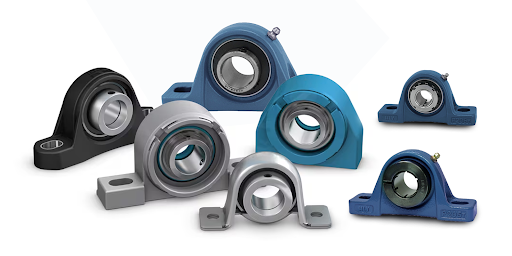
The pillow block, or Plummer block bearing, is an essential component in many machines that supports rotary shafts and allows motion to occur in an industrial environment. Pillow block bearings are mechanical devices that reduce friction, support loads, and provide reliability in demanding applications in a range of industries such as: automotive, manufacturing, agricultural, aerospace, and military. The pillow block bearing itself is not difficult to manufacture, but it does require a systems approach to manufacturing in context of metallurgy, engineering, and quality control as a whole unit in terms of mechanical function.
Material Selection
The first step in a manufacturing process is determining what material is used. The housing is the outer casing and is usually made from cast iron or ductile iron because of their strength, toughness and price. Stainless steel or thermoplastic housings, however, will be the choice of material for environments with corrosion resistance. The bearing inserts carry the load of the bearing and transfer the rotational motion. Also, bearing inserts are usually made from high-carbon chromium steel to provide superior fatigue resistance and wear resistance. The choice of material will ensure that pillow block bearings operate consistently in different industrial circumstances.


Casting and Forging
The next stage involves forming raw parts into usable forms. Most housings are made from castings, where hot metal is poured into Molds to make a shape. Bearing rings and rolling elements, in contrast, are made from forgings, which realigns the flow of the grain and therefore strengthens and tightens the structure. The combination of casting with forging is the best compromise of cost and mechanical strength.
Heat Treatment and Machining
In order to achieve hardness and fatigue life, bearing inserts are heat treated by annealing, quenching, and tempering. After heat treatment, dimensions of the housing and bearing rings are machined to precision; CNC machines are typical for the high precision. Additional grinding and polishing operations are done to improve surface finish and reduce friction for smooth rotation.
Assembly and Sealing
Once the components have been produced and the bearing insert is assembled into the housing with seals, cages, and lubrication, the seals will keep dust, dirt, and contaminants out of the bearing and extend the life of the operation. The pillow block bearing may have either grease or oil lubrication systems that allow for ongoing smooth motion depending on the application.
Quality Control
Quality inspections to test reliability and performance are done during all stages of the production process. Non-destructive testing (NDT), dimensional inspections, and load testing ensure pillow block bearings are clearly meeting industry standards like ISO and ANSI.
This quality assurance is an important process due to the function of pillow block bearings in critical systems which would otherwise entail costly downtime or unsafe outcomes if they should fail.
Applications and Significance
Pillow block bearings provide strong construction and adaptability for a range of uses. In agriculture they hold rotating shafts in tractors and harvesters. In manufacturing they allow conveyors, textile processes and packaging devices to operate effectively. Heavy industries (mining, construction, etc.) make use of pillow block bearings because of their load-carrying capacity and durability. Their utility is not exclusively in mechanical efficiency, but also in workplace safety and lower maintenance costs.
Conclusion
The uncomplicated observation of the product cycle in pillow block bearing manufacture will show the coordination of metals, engineering precision and quality assurance for a reliable product innovative to the modern industry, but from material selection to last inspection, every step involved the process is vital in producing a pillow block bearing that meets long service life, lowest possible maintenance, and highest performance. In advancing industries, the demand for advanced pillow block bearings with higher efficiency and specialized applications will continue to grow, so need for constant innovation in manufacturing process would also have to be mirrored in the pillow block bearing.